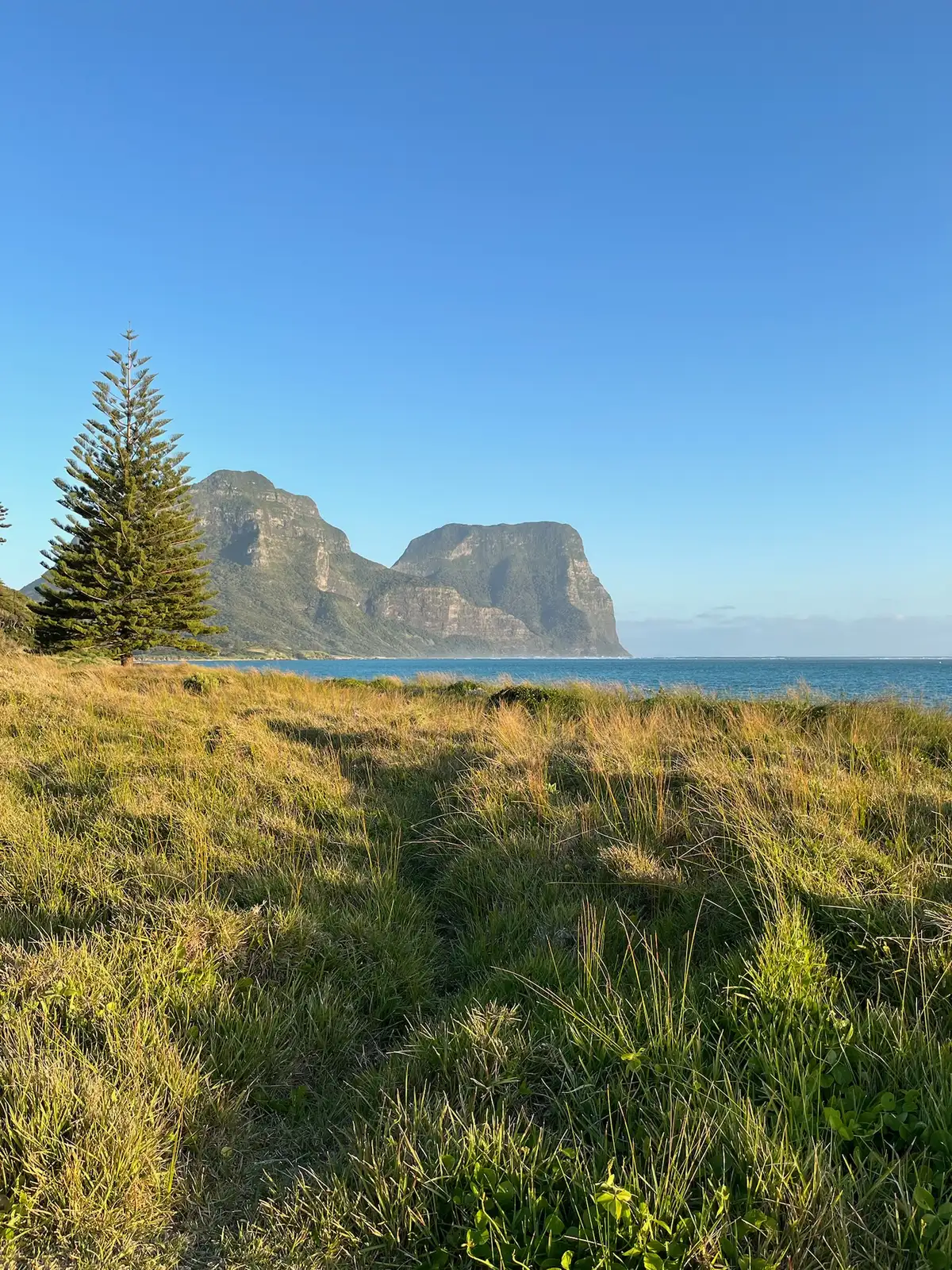
Stepping Into a Different World
I've tried to explain Lord Howe Island to people since I got back and the best I can do is this: it's like stepping back in time. Not in a run-down way. In a "the world used to be like this and we forgot" kind of way. The air is different. The pace is different. The fact that you can hear birds instead of traffic, that people wave at you from their bikes, that the water in the lagoon is so clear you can see every fish from the shore.
My brother and I arrived in September, just the two of us for his buck's weekend. No big plans, no packed schedule. Just a rough idea of things we wanted to try and a couple of bikes to get us there.
Mount Gower: The Centrepiece
If you do one thing on Lord Howe, make it the Mount Gower hike. It's the signature experience of the island and it earned that reputation.
The stats: 875 metres elevation, roughly 12km return, 8-9 hours with a guide. You have to go with a licensed guide because the track is unmarked in places and there are sections where a wrong step means a very long fall. The island board requires it, and after doing the hike, I understand why. This is not a casual walk. This is a proper alpine hike with exposure.
There are only one or two guides who take people up Mount Gower, so you book with one of them. It runs on set days, usually Mondays and Thursdays, with a maximum group size of about 10-12 people. You need to book ahead, ideally on your first day or before you arrive. Don't assume you can just rock up, especially in peak season.
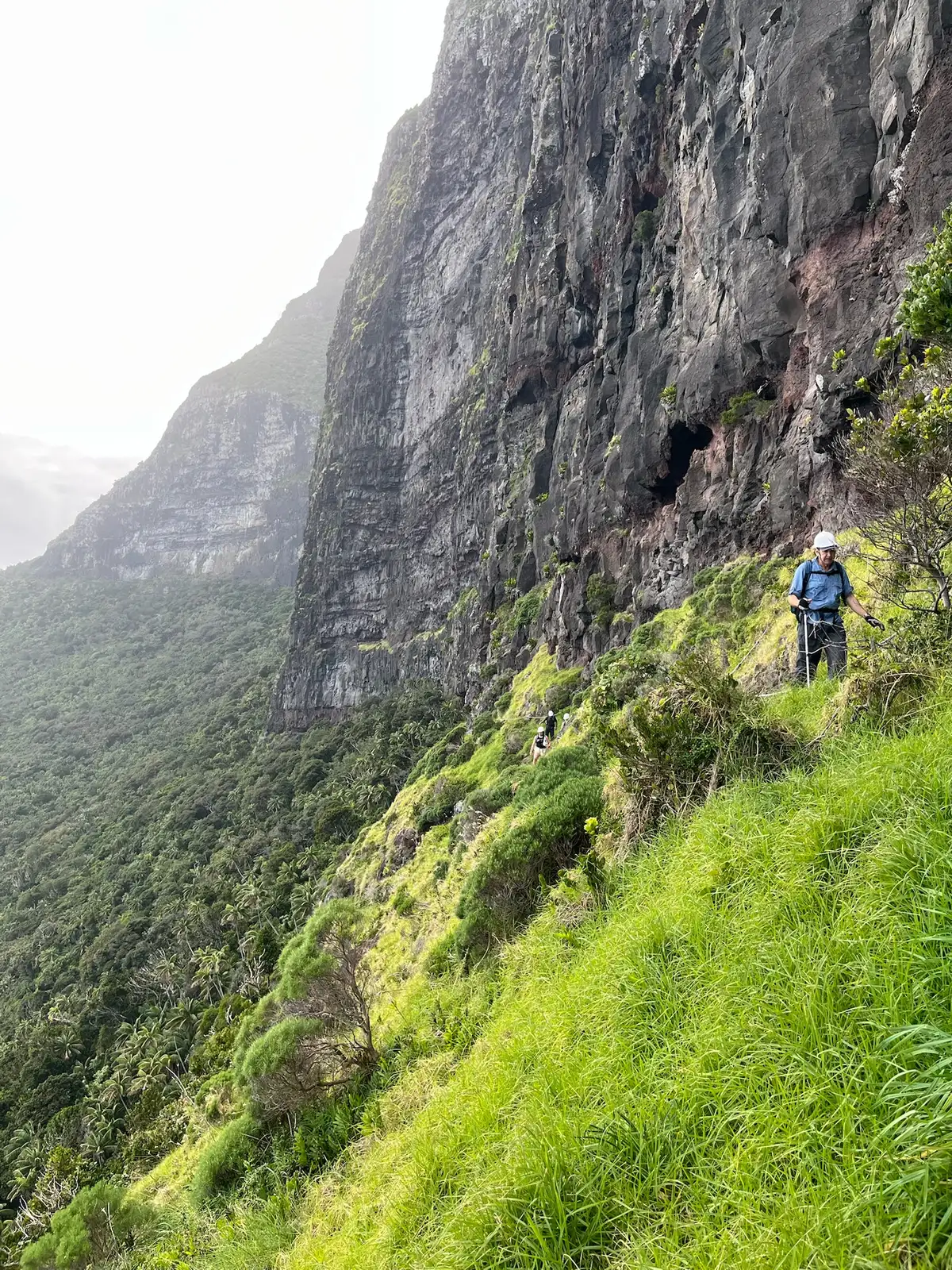
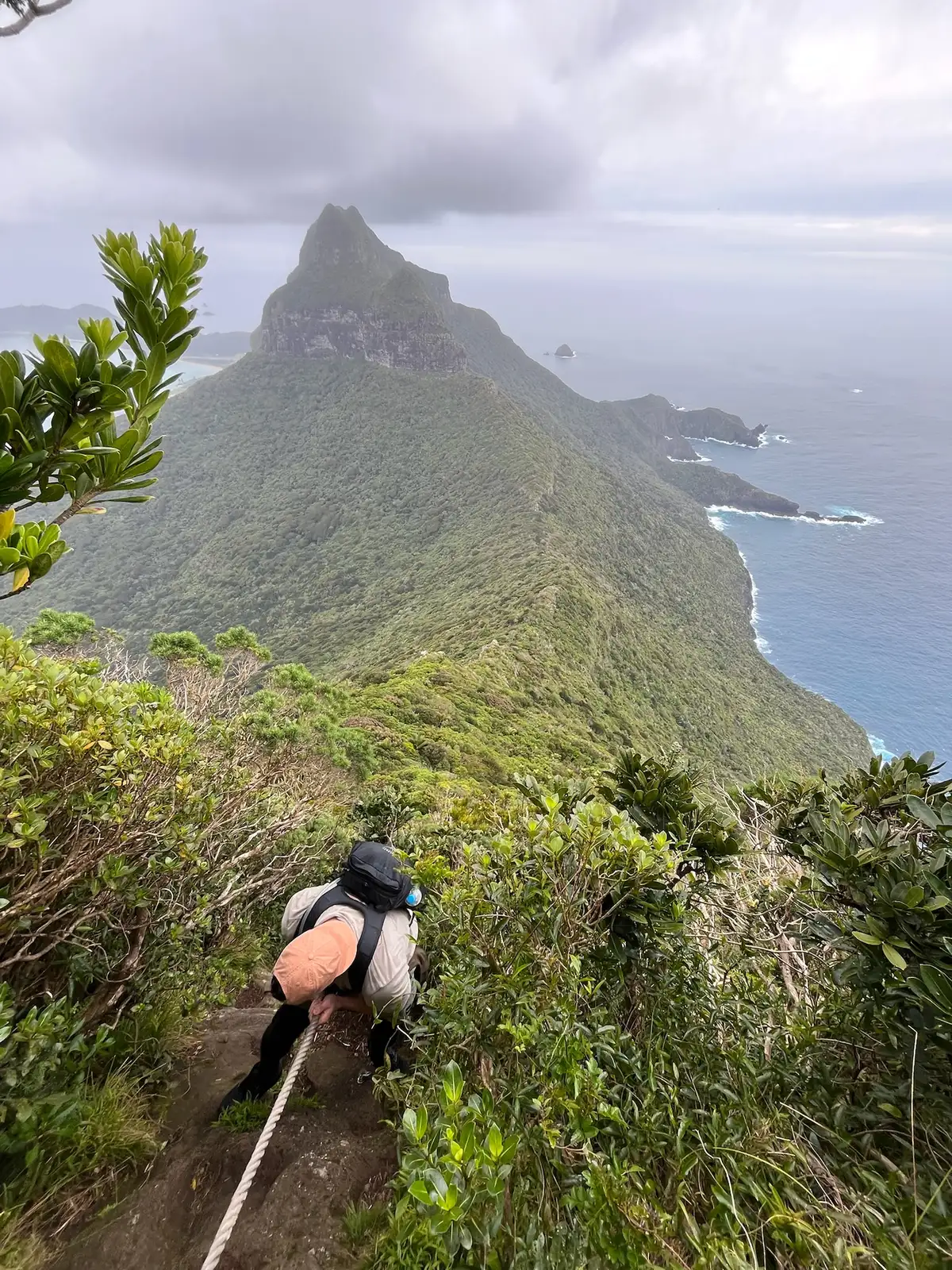
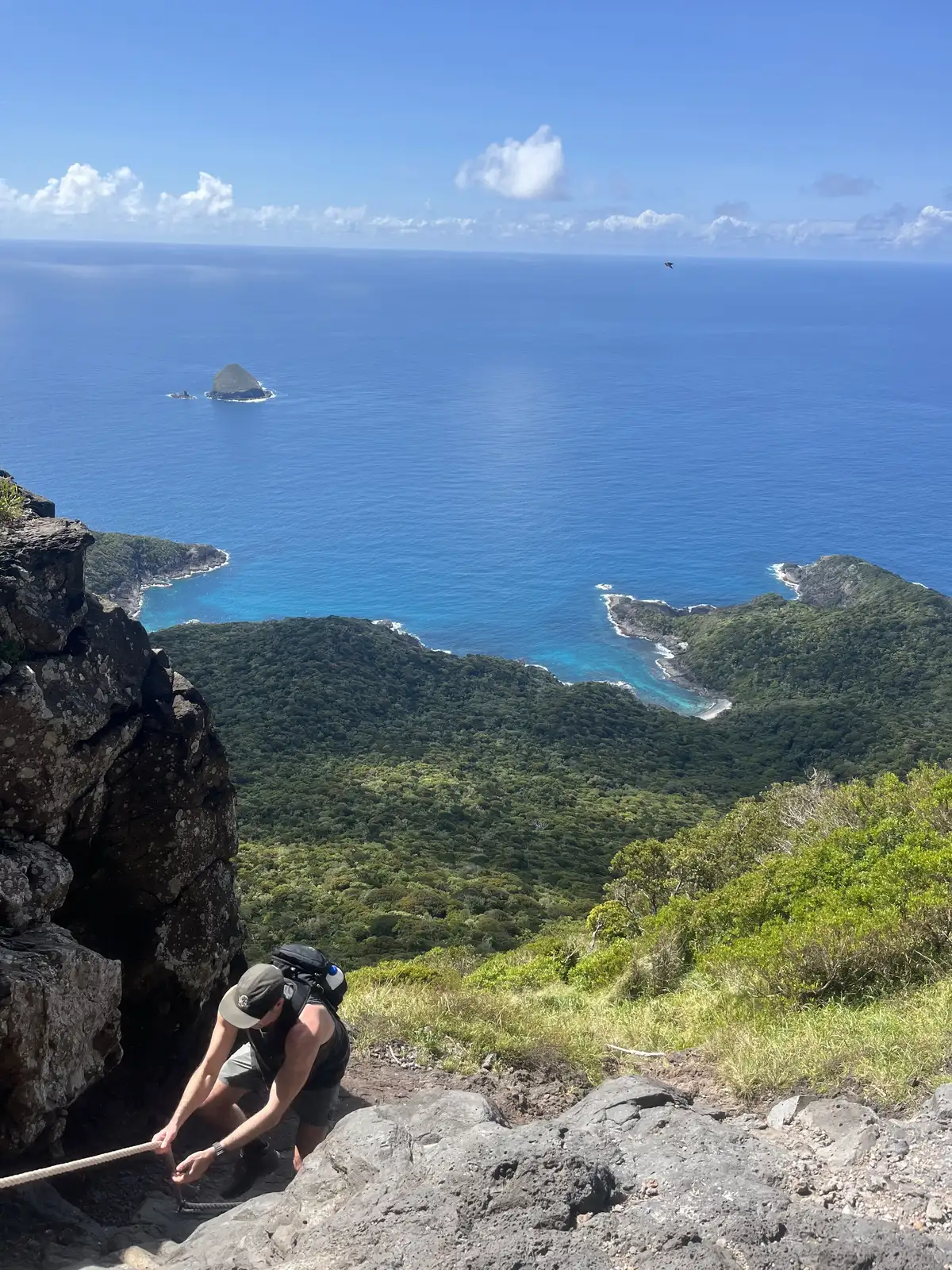
The hike starts gentle enough, through lowland forest with big tree ferns and dense vegetation. The trail is marked with tape and paint blazes in the lower sections. Then it gets steep, legitimately steep, and you start using your hands to pull yourself up. Then there are ropes. Some sections require actual hand-over-hand climbing on fixed ropes, your feet finding purchase on rocky ledges. If you're not comfortable with heights, there's a part called Lower Road where you're walking along a narrow ledge with cliffs dropping away on one side. My hands were sweating on that section, and I'm not someone who's normally bothered by heights.
The rope sections are manageable if you take your time. Our guide brought light gloves for everyone, which made a huge difference. Your palms get torn up without them. The guide also made sure the whole group was secure and confident before moving on. It's not a race. It's a guided experience designed to be safe.
But then you get to the top. The summit is what they call a "cloud forest," and on a clear day like we got lucky with, the views are insane. You can see the entire island below you, the lagoon, the reef, Balls Pyramid in the distance. You can see Bowral Island and the northern outcrops. The ocean stretches out in all directions. We sat up there eating sandwiches from the local cafe and just staring. It's one of those moments that reminds you why you travel.
The cloud forest at the top is genuinely unique. There's a plant species up there, the endemic wood fern, that only grows on Mount Gower. The vegetation is dense and dripping and feels primordial. The temperature drops as you climb, and the humidity is high. By the time you summit, you're in a different ecosystem from where you started.
The palm tree climbing. One of the best random moments of the trip. Our guide showed us how the locals climb palm trees, barefoot, using a technique where you wrap something around the trunk and shimmy up using a combination of arm pull and leg push. I had a go and actually made it up about 3 metres. It's one of those things you'd never do anywhere else, and it's the kind of detail that makes a guided hike worth the money compared to just walking on your own. The guide also shared stories about growing up on the island, what it was like before the rat eradication, how the bird life has changed.
Fitness wise, it's graded hard but achievable if you have reasonable fitness. The elevation gain is significant but spread over distance. The scrambling is where fitness helps, but good footwork and a steady pace matter more than strength. I'm not a serious hiker and I completed it fine. If you can walk 12km with some elevation, you can do this hike. If you're terrified of heights, this particular hike will test you. The Lower Road section has significant exposure, and there's no protection if you fall. It's not technically difficult, but mentally it requires comfort with heights.
I'd recommend taking a packed lunch (the cafes do sandwiches), at least 2 litres of water, sturdy boots with ankle support, and gloves for the rope sections. A raincoat too, because the summit gets cloud even on sunny days. Sometimes you summit into cloud and see nothing, but you still get the sense of being on top of a high peak. The physical achievement matters more than the views.
The Reef and the Sharks
Lord Howe Island sits on the world's most southerly coral reef, and the marine life is something else. The lagoon is sheltered, crystal clear, and you can snorkel right off the beach in several spots without needing a boat. The water in September was cool (around 20-21°C), so a rashie or thin wetsuit made a difference for comfort on longer snorkels.
But the thing that blew my mind was the Galapagos sharks. Lord Howe is one of the only places in Australia where you can see Galapagos whaler sharks, and we're not talking about one or two. We saw hundreds. At one time. Just cruising through the shallows near the reef edge. The tour operators (Dive Lord Howe and Reef N Beyond are the two main ones) run shark encounter snorkeling trips where they take you out to known congregation spots.
It sounds terrifying, but the sharks are not interested in you at all. They're reef sharks, not aggressive, and the guides brief you on how to behave in the water. Basically, stay calm, move smoothly, and let them do their thing. You float on the surface and watch them glide underneath you. I've snorkeled in a lot of places and I've never seen anything close to this. The clarity, the sheer number of sharks, the calmness of the interaction. It's genuinely one of the best wildlife experiences I've had.
The reef itself is pristine. Because the island limits tourist numbers and the marine park is strictly managed, the coral is healthy, the fish are everywhere, and the water visibility is ridiculous. Ned's Beach is the famous spot where you can feed fish right from the shore for $2, and the fish literally swarm your feet. It's surreal the first time you do it. You step in the water with a cup of food, and within seconds you're surrounded by hundreds of fish all trying to eat from your hands and feet. Kids love this. Adults love it. It's peak snorkeling tourism done right: fun, accessible, and managed so the fish aren't overstressed.
Scuba Diving
If you dive, Lord Howe is worth staying longer for. There are over 60 dive sites around the island, ranging from shallow lagoon sites to dramatic deep walls off the volcanic coast. The water temperature in September was cool enough that a 5mm or 7mm wetsuit was worth it, and there's good reason for the thermal protection: the deeper you go, the colder it gets.
The volcanic walls are the signature of Lord Howe diving. Steep drop-offs into deep water, lots of structure for fish to shelter in, and a mix of tropical species at the limit of their range and temperate species common further south. You get pelagics, big groupers, lots of rays. The visibility is usually excellent (15-40 metres depending on conditions and site).
Both main dive operators (Dive Lord Howe and Reef N Beyond) offer guided boat dives, certification courses, and equipment rental. A guided two-tank dive runs around $200-250. If you're already certified, dives are straightforward to arrange. If you want to get certified, you have time to do the openwater course on the island, but book in advance.
Scuba diving offers a different perspective from snorkeling. Where snorkeling is about seeing things at the surface, diving gets you down to the structure. You see the reef ecosystem at different depths. On the wall dives, you're often seeing species that don't come into the shallows. It's worth the investment if diving appeals to you.
The Island Community
Something I didn't expect was how tight the community is. Lord Howe has about 300 permanent residents, and they all know each other. The operators running the dive shops, the bike hire, the cafes, these are families who've been there for generations. Some of them were born on the island and have never left. Others came here 20 or 30 years ago and decided to stay. They're not hustling for tourist dollars. They're just doing their thing, and you're welcome to be part of it for a few days.
You couldn't move there if you wanted to. There's apparently a system where you have to go into a lottery or some kind of allocation process if you want to buy land or become a permanent resident. It's not like you can just buy a house on Lord Howe. The community is protected, and it shows in how the island feels. There's no overdevelopment, no chain restaurants, no resort strip. Just small businesses run by people who genuinely love where they live.
The bowls club is worth a visit if you want a taste of island social life. Cold beer, the footy on TV (if it's season), and locals who are happy to have a yarn. It's the closest thing to "going out" on Lord Howe, and it's brilliant for what it is. We had a proper dinner there one night, pub-style food, and the vibe was so relaxed and friendly.
The Bird Life
One thing people don't know about Lord Howe is that they completed a massive rat eradication program. Before that, rats, introduced by ships centuries ago, were destroying native bird populations. The rats ate eggs, killed chicks, competed for food. Since the eradication (which happened in 2019), the bird life has exploded. Walking around the island now, birds are everywhere: on the paths, in the trees, on the beach. Providence Petrels on Mount Gower will literally land on your hand during breeding season (March to October). There are 14 seabird species nesting on the island.
It's become one of Australia's premier birdwatching destinations, and even if you're not a birdwatcher, you notice it. The island feels alive in a way that most places don't. The acoustic environment is different. Instead of the ambient drone of traffic or human activity, you hear actual natural soundscape: bird calls, wind in the vegetation, waves, insects. It's remarkable.
Golf and Other Activities
The Lord Howe Island Golf Course is a small 9-hole course, nothing like a mainland club. But playing a round with Mount Gower as the backdrop, parrots flying past, and birds wandering across the fairway is something else. It's relaxed, cheap (about $20 for a round), and a good way to spend an afternoon when your legs are recovering from other activities. My brother is a proper golfer and I'm terrible, and we both had a great time. The course is short and forgiving, and the setting is beautiful.
There's also kayaking and stand-up paddleboarding in the lagoon if your accommodation has access to equipment. Some places provide it free, others rent it cheaply. The water is calm in the lagoon and the visibility is insane, so you're literally paddling over fish.
The Volcanic Origins and Geology
Lord Howe is a volcanic island, the remnant of a shield volcano that erupted about 7 million years ago. Balls Pyramid, that dramatic sea stack you can see from the island, is actually the world's tallest volcanic stack at 551 metres. The volcanic origin is why the underwater terrain is so dramatic: steep walls dropping into deep water right off the reef, which creates some of the best dive sites in Australia.
The island itself is small. About 11km long and 2km at its widest. You can see both sides from certain vantage points. And because it's volcanic, the soil is rich, which is why the vegetation is so dense and unique. The cloud forest on top of Mount Gower has plant species that exist nowhere else on earth. That isolation has created an ecosystem unlike anywhere else.
Would I Go Back?
100%. Without question. Lord Howe is one of those rare places that lives up to the hype and then some. I told my wife about it within hours of landing back in Sydney, and we've already talked about going together. Different trip, different vibe, but the same island that stopped me in my tracks.
What sticks with me most isn't any single moment, though the sharks and the summit come close. It's the overall feeling of the place. After three days, I stopped reaching for my phone. Not because I couldn't use it (no reception anyway), but because I didn't want to. I was just existing in a place where the natural environment was so engaging that distraction felt pointless. That's rare. Most holidays are an escape from your routine, but Lord Howe felt like a recalibration. You come back with a different baseline for what "quiet" means.
The buck's trip format worked perfectly for this. Just the two of us, no big group dynamics, no competing itineraries. We ate when we were hungry, hiked when we felt like it, and spent the rest of the time riding bikes and floating in the lagoon. Simple. But simple done in a setting like this is better than complicated done anywhere else.
The one thing I'd say to someone on the fence: just go. It's expensive to get there, yes. The logistics are a bit old school, yes. But you will not regret it. You'll spend a week on an island where nature runs the show, where the reef is healthy, where the sharks swim past you without a care, and where the hardest decision you make each day is "beach or hike?"
Paradise. That's the word. And I mean it.
Stay Wild
Real stories from real places. No spam.