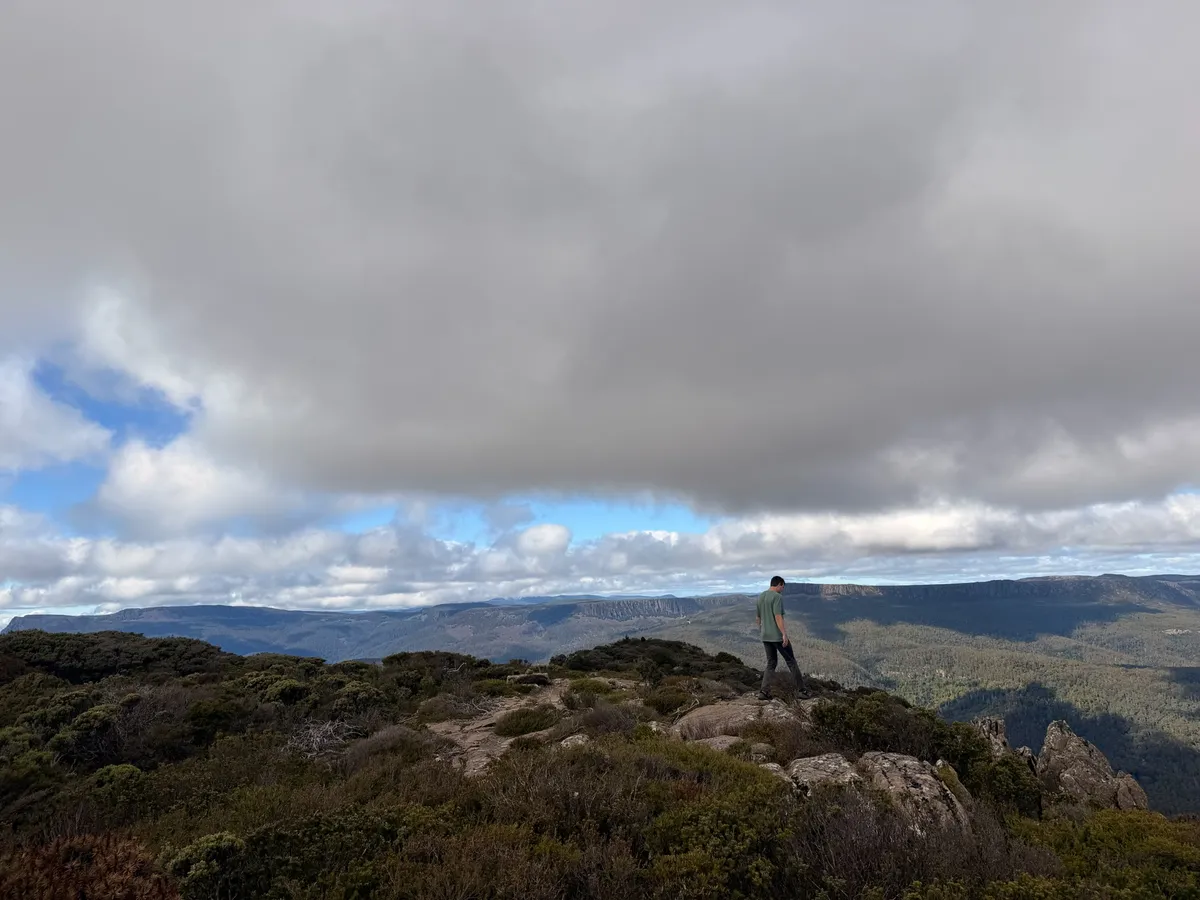
Grade 3 according to Tasmania Parks. That means moderate difficulty with some scrambling required. The first half through rainforest is straightforward walking on a dirt path with some rocky sections. The second half involves crossing a boulder field on hands and feet and some short rock climbing near the summit where you pull yourself up 1 to 2 metre rock faces. Anyone with reasonable fitness and confidence on uneven ground will manage it. We completed it in 3 hours and 15 minutes at a comfortable pace, including 20 minutes sitting at the summit.
Most people take 3 to 5 hours return, depending on fitness and how long you spend at the summit. We did it in 3 hours 15 minutes including about 20 minutes on the summit. AllTrails lists it as 4 to 5 hours, which is conservative but accounts for people taking a longer break at the top. I would suggest budgeting 4 hours to give yourself time to enjoy the summit, take photos, and not rush the boulder field on the way down.
Without question. For a half-day hike near Launceston, it is one of the best options in the region. The 360-degree summit views are genuinely spectacular, the rainforest is beautiful, and the boulder scrambling adds enough challenge to make it feel like a proper achievement rather than just a walk. We paired it with raspberry pancakes at Christmas Hills Raspberry Farm (five minutes away) and ice cream at Van Diemen's Land Creamery next door. Hike in the morning, eat all afternoon. Perfect day.
The summit is 1,227 metres above sea level. The trailhead sits at around 700m, so you are climbing approximately 500 metres over 3km.
I would not recommend it. The boulder field and the rock climbing sections near the summit would be slippery and potentially dangerous when wet. The summit views are also the main reward, and you will not see anything through cloud. Wait for a clear day.
Yes, a small gravel car park accessed via Highlands Lake Road, just off the Bass Highway. It fits roughly 10 to 15 cars. There are no toilets or facilities. Arrive early on weekends and holidays.
Not necessarily. We did the whole hike in standard Nike running shoes on a dry day and had no issues. Trail runners with good grip would be ideal. Hiking boots are a good idea if conditions are wet or if you want extra ankle support for the boulder field.
We saw a potoroo near the trailhead, a native Tasmanian rat on the path, and small shrub birds near the summit. Reviewers on AllTrails mention it as a good birding location. Fungi enthusiasts will be in heaven; we saw red, yellow, and brown fungi on almost every tree in the lower forest. Snakes are present in the area but we did not encounter any.
About 60km or 50 minutes drive via the Bass Highway (A1). The trailhead is approximately 20km south of Deloraine.
Yes. It is the northernmost peak in the Tasmanian Wilderness World Heritage Area and part of the Great Western Tiers mountain range.
The Great Western Tiers are a mountain range forming the northern edge of Tasmania's Central Plateau. They stretch over 100km and include dozens of walking tracks, waterfalls, and lookouts. Quamby Bluff is the most accessible summit in the range and a great introduction to hiking in the area.
October through April for the warmest and driest conditions. Summer (December to February) gives the best weather and longest days. We hiked in early April (Easter) and had good conditions. Winter is possible for experienced hikers, but expect cold, potential snow, and reduced visibility.
Probably, though we did not see any on our April hike. Tiger snakes and copperheads are found across Tasmania. Some AllTrails reviewers have mentioned seeing snakes on the lower trail in summer. Stick to the trail, watch where you step particularly in the grassy sections, and make noise as you walk through the forest. The risk is low but real, particularly December through March when snakes are most active.
Older kids (10 and up) who are confident on rocky ground and comfortable with some scrambling could manage it with supervision. The boulder field and summit climbing sections are not suitable for young children. There is no protection from falls in the boulder section and the summit rock climbs require upper body strength. For families with smaller kids, Liffey Falls is a much better option: a flat 2km walk to a stunning multi-tiered waterfall, about 30 minutes drive away, and suitable for all ages.
This is the best part of a Quamby Bluff day trip. Christmas Hills Raspberry Farm is five minutes away on the Bass Highway with raspberry pancakes and hand-dipped chocolate-coated raspberries. Van Diemen's Land Creamery is right next door with 24 flavours of ice cream. Trowunna Wildlife Sanctuary is 12 minutes west towards Mole Creek where you can see Tasmanian devils up close with feeding tours at 11am, 1pm, and 3pm. Deloraine itself is worth a wander for cafes and a riverside walk along the Meander River where you might spot platypus.
No. The trail passes through the Tasmanian Wilderness World Heritage Area where dogs are not permitted.
No. There is no entry fee, no permit required, and no booking needed. Just show up at the car park and start walking. The trail is open year-round, though winter conditions at the summit can be harsh with potential snow and ice.
New dispatches from the field
Real stories. No spam. Unsubscribe anytime.