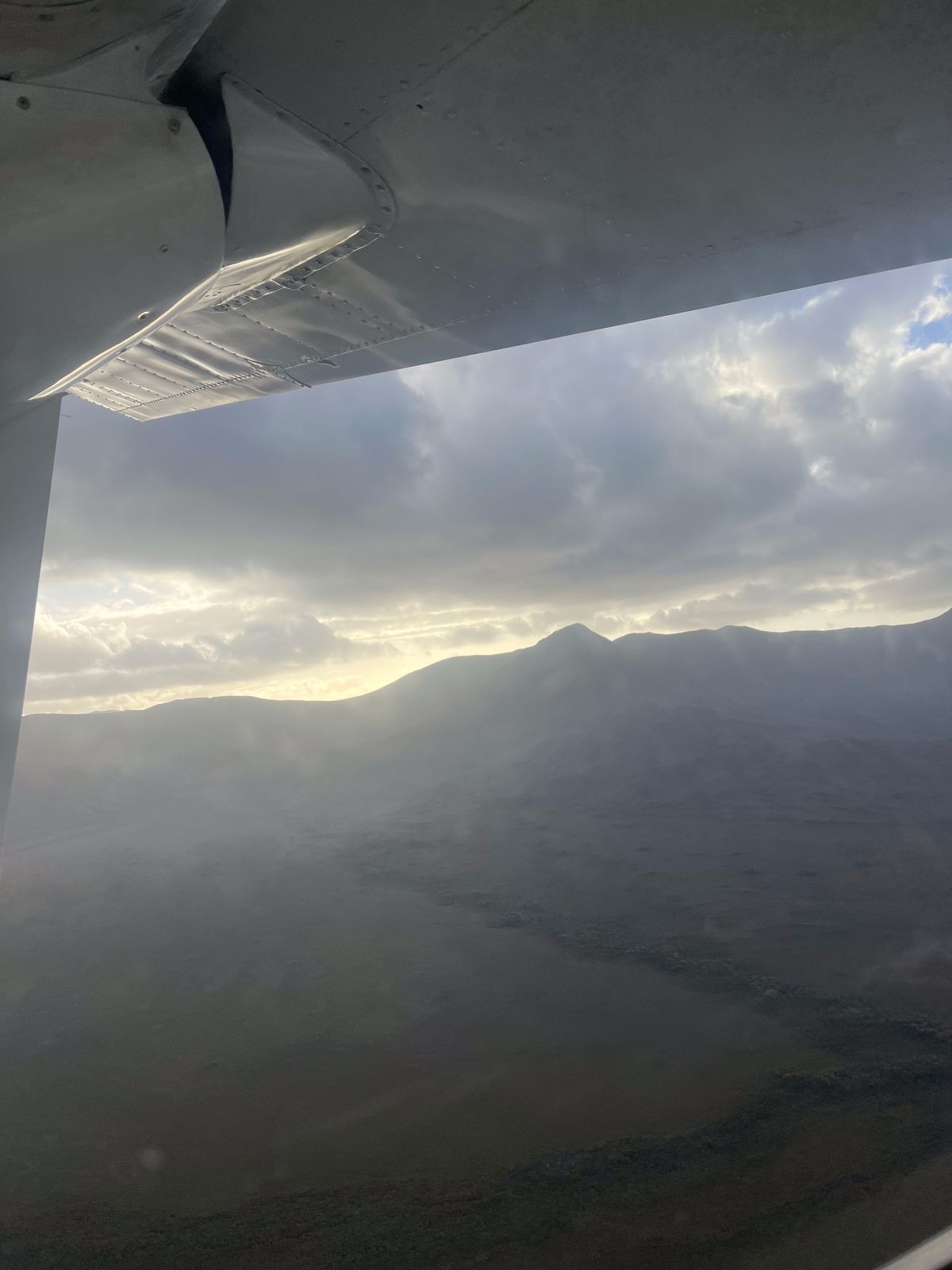
What Actually Happens Out There
The South Coast Track experience is nothing like the tourism photos suggest. Let me be direct: the first night was miserable. I'd been prepared, or thought I had. I had my Kmart tent (mistake number one), my 15-degree sleeping bag (mistake number two when real temps were eight degrees), and my confidence that I was physically fit and this would be fine.
Then the rain started. It didn't ease or drizzle. It rained properly, consistently, the kind of rain that comes sideways and finds every seam in a Kmart tent. I sat in there eating pasta from a metal cup, soaking wet, wondering why I'd voluntarily left civilization.
By the morning of day two, I hadn't slept at all. Neither was I dry. Neither was anything else. And I had eight more days of this ahead of me.
The First Crossing and the Storm
Day one isn't the hardest section physically, but it's psychologically critical because you're still processing the reality that you're committed now. Most hikers start by walking south from Melaleuca towards the first tidal crossing at Cox Bight.
This crossing is tidal. You can't cross at high tide because the water is too high and the swell is dangerous. You have to time it during the low tide window. This is in the guidebook. This is non-negotiable.
I read the tides wrong. I arrived at the crossing as the tide was coming in, not going out. So I waited. The other hiker option is to sit on the beach and wait for low tide while the wind picks up and a storm system moves in. This is exactly what happened.
I watched the sky change colour. I watched the wind pick up from "strong" to "genuinely dangerous." I watched the swell grow. And I watched the low tide window close without me being able to cross safely. So I camped right there, still dry enough, still fed enough, but now understanding that the track operates on its own schedule and you either adapt or you suffer.
The crossing the next morning, at proper low tide, was fine. The actual crossing is not technically difficult. It's just exposed. You're walking across a beach with nothing to shelter you, and if the tide comes in while you're on the wrong section, you're in real trouble.
But that first night watching the storm roll in was the moment I understood this wasn't a hike. It was a test.
The Sound of Isolation
Something people don't write about enough: the sounds on the South Coast Track. Or more accurately, the absence of sounds you're used to.
No cars. No planes overhead. No hum of electricity. No other people talking. For the first 24 hours, my ears kept searching for familiar noise and finding nothing. Just wind, water, and the occasional bird.
By day three, I'd tuned into the bush sounds. The crack of a branch that meant something was moving nearby (usually a wombat, occasionally something bigger). The shift in wind direction that preceded weather changes. The particular silence that meant dawn was about to break.
At night, the darkness is total. Not city darkness where there's always a glow on the horizon. Total darkness. My headlamp was the only light source for kilometres in every direction. I'd turn it off sometimes and just sit in the dark, listening. It's either peaceful or terrifying depending on your state of mind that particular evening.
The second trip, my partner mentioned the silence first. "Why is it so quiet?" she asked on day one. By day five, she said the quiet was her favourite part. By day eight, she dreaded going back to the noise. That's the arc most people experience.
Day Three to Five: The Ironbound Range
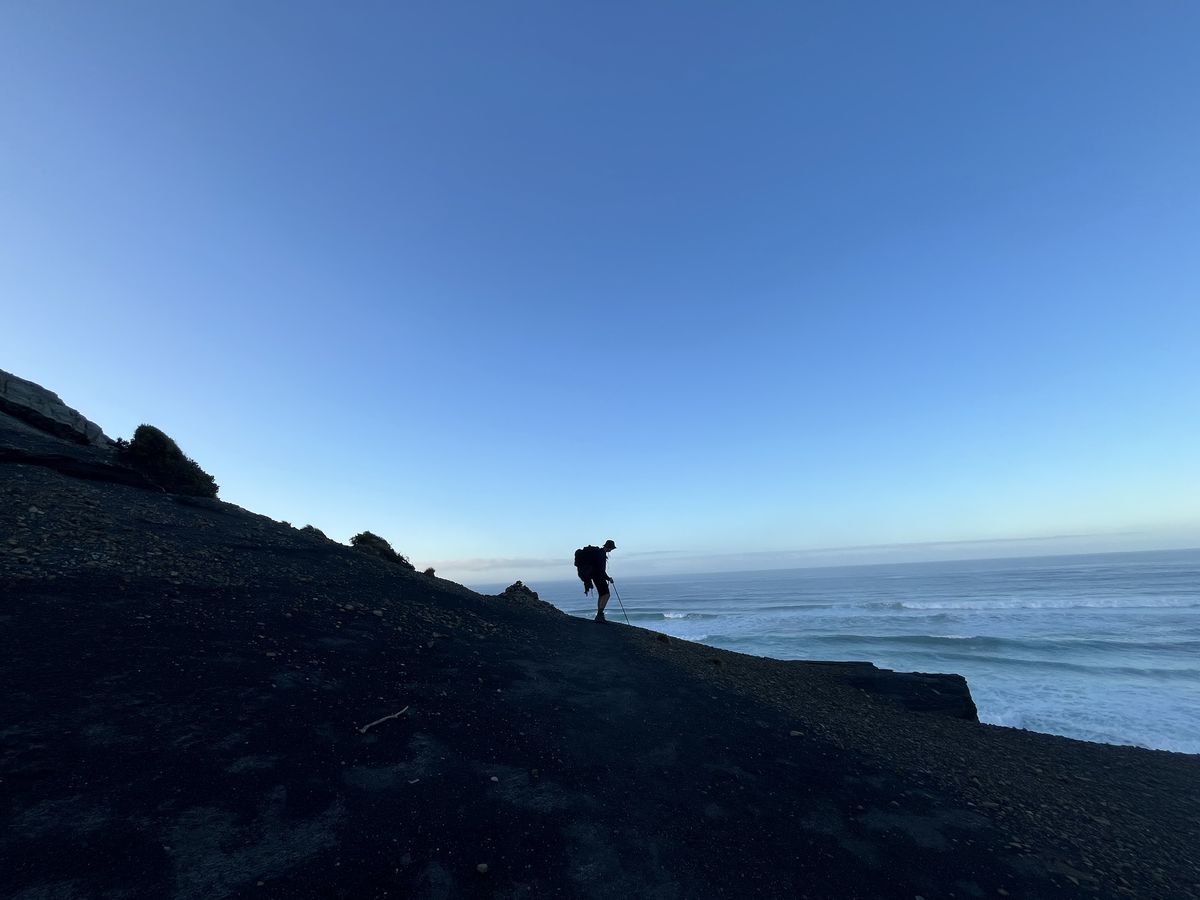
The Ironbound Range is the physical heart of the South Coast Track. It's where the elevation gain happens. It's where the exposed ridgelines hit you. And it's where people have real accidents.
My experience in January 2020 was cold and wet. The temperature was probably 12 degrees, the wind was probably 40 to 50 kilometres per hour, and the sleet was enough that visibility became a genuine concern. I've hiked in mountains in better conditions, but not many.
The guidebook times say three hours. I took five. The mud was to my knees in places. The wind wanted me off the ridge. The exhaustion from being cold and wet and sleep-deprived compounds. By the time I hit the peak, I wasn't thinking clearly anymore. I was just moving forward.
There's a section called Granite Rock that is legitimately exposed. You're walking along a ridge with significant drops on both sides. It's only exposed for a hundred metres or so, but those hundred metres require attention. I slipped. My boot lost traction. For maybe one second, I thought I was going down. I caught myself with my hands and kept moving. That moment is why I'm so particular about footwear. Salomon boots kept me on the rock when other boots wouldn't have.
The risk of hypothermia on Ironbound Range is real. If weather gets worse than what I experienced, if someone is underdressed, if exhaustion sets in and heat loss accelerates, this is where people die on otherwise "moderate" tracks. The track is maintained, so there's no navigation difficulty. The difficulty is endurance in bad conditions.
By the evening of day four, I'd made it to Granite Beach and my actual first decent sleep happened (not much decent, still cold, but actual sleep). My body had stopped fighting the conditions and started accepting them. The shivering reduced. My appetite came back. Something clicked where I stopped resisting the discomfort and just existed in it.
The worst section was behind me. Nothing ahead was as bad. From that point, it was a matter of completing the distance and not making mistakes. I remember sitting on a rock at Granite Beach eating reconstituted pasta and genuinely smiling for the first time in four days.
The Wildlife and Your Food
This is specific but critical: wildlife on the South Coast Track will destroy your food if you don't store it correctly.
I triple-bagged my food. I put everything in stuff sacks, then in dry bags, then in my pack. The wildlife still got through and ate into seven or more of my bags. I lost about a week's worth of snacks. The weight loss was noticeable. On day six, I was rationing calories. I was hungry. This was avoidable.
The solution is simple but requires you to actually do it: string your bag 1 to 2 metres off the ground between two trees. This is the standard practice in bear country, and it works for everything. Possums, quolls, wombats, and whatever else roams these areas at night won't climb to a bag hanging above them.
I didn't do this the first night. I learned. Second night, I started hanging my food. The next morning, no damage. Lesson learned the hard way.
Pack enough food, hang it every night, and you won't be hungry. Get this wrong and you'll experience a genuine food shortage which compounds all other challenges.
Solo Versus Partnership
The second time I did the track with my partner, everything was different. Not because the track changed, but because the experience becomes social.
On my solo trip, I spent 10 days alone. There's something about solo wilderness that's both meditative and isolating. I wasn't lonely exactly, but I was aware of being completely alone. If something went wrong, I was the only person who could fix it. This creates a mental state that's focused but also slightly paranoid.
With my partner, the challenges became shared. Cold nights in the tent meant conversation and body heat. Difficult climbs meant encouragement and pace matching. The isolation became companionship. The danger became manageable because it was distributed.
Both experiences are valid. The solo trip was transformative. The partnership trip was better. Choose based on what you actually need from the experience.
If you're going through something difficult, like I was, solo is powerful. There's nowhere to hide from yourself when you're alone for 10 days. Every thought you've been avoiding will find you on that track. For me, that's what I needed. I walked away from redundancy and heartbreak and by day 10, I wasn't carrying those things anymore. Not because I'd processed them intellectually, but because the physical and mental demands of the track had created enough distance that they didn't weigh as much.
If you're going with someone, the track will test the relationship. Not because it creates conflict, but because it strips away all the buffers you normally have. No restaurants to go to when conversation dries up. No TV to watch when you're annoyed with each other. Just you, them, a tent, and the rain. If you can be genuinely good company for each other under those conditions, you've got something solid.
The Close Calls
I've mentioned two moments where things went badly. Let me be specific because these illustrate why preparation matters.
Granite Rock slipping: I slipped on a wet rock on an exposed ridge. One second my foot was secure. The next it wasn't. I caught myself with my hands and the momentum was controlled. If my boot had been different, if my reflexes had been slower, if the drop had been vertical instead of sloped, this becomes a different story. Someone dies on this ridge roughly once every five years. It's always because they underestimated the exposure or made a mistake. I made a mistake and got lucky.
South Cape Rivulet panic: Day six, I got lost. The track marking was unclear in a section where the map and reality didn't quite line up. I panicked. I stopped thinking and started running. Running on uneven terrain while exhausted is how you fall. I fell down a slope and a stick I was trying to grab for stability hit my chest and slid off my rib cage. If that stick had been a few centimetres more towards my centre, it would have gone between my ribs and potentially punctured a lung.
Both of these moments happened because I was tired, I wasn't thinking clearly, and I made mistakes. The second time, with experience, I navigated challenging sections more carefully. I didn't panic. I didn't run. This is the difference experience makes.
The Mental Space
By day five, your body has accepted the constant state of being damp and cold. By day seven, your mind has fully adapted to the rhythm of walking, camping, eating, sleeping, walking again. By day eight, you're thinking clearly again and the track feels almost routine.
The mental experience is strange. The constant problem-solving (water, camp, food, weather, navigation) leaves little mental space for worry about the outside world. Your job, your relationship issues, your financial stress, none of it matters when you're focused on not falling into a river and finding a decent campsite.
This is therapeutic for some people. For me, it was exactly what I needed after redundancy and heartbreak. For my partner the second time, it was a reset. For some people, it's just a really hard hike and they don't romanticise the struggle.
All of these are valid. The track doesn't care about your emotional journey. It just presents challenges and you respond to them.
The Physical Toll
Nobody talks enough about what 10 days of continuous hiking does to your body. By day four, my feet were swollen. Not blistered (my Salomon boots prevented that), but swollen from being constantly wet and under load. I'd take my boots off at camp and my feet would be white and pruned, like I'd been in a bathtub for a week.
My shoulders had pressure bruises from the pack straps despite the hip belt carrying most of the weight. My lower back ached from the constant forward lean on steep sections. My knees, which had never been a problem before, started clicking on descents by day five.
The weight loss was real. On my first trip, I lost visible mass in my arms and face. I didn't have scales, but my pack belt needed tightening twice during the trip. Part of this was undereating (my food miscalculation), but part of it was simply the calorie burn. You're walking 8 to 10 hours a day in cold conditions carrying 20+ kilograms. The energy expenditure is enormous.
The second trip, with better food planning and more body awareness, the toll was less severe. I still lost weight but I wasn't ravenous by day six. My partner handled it differently. She was sore but never complained about hunger. She'd packed more trail mix than me. Smarter.
Recovery after the track takes about a week. Your feet need time to shrink back to normal. Your muscles need rest. Your sleep patterns take a few days to normalise because you've been going to bed at 7pm and waking at 5am for ten straight days. I remember sitting on the couch three days after finishing my first trip, and my legs just cramped. Full calf cramp, both legs. My body was still catching up to the fact that I'd stopped moving.
The emotional recovery is different. For about a week after my first trip, I felt strangely empty. Not depressed. Just quiet. Like the noise of normal life hadn't fully registered yet. Everything seemed trivially easy. Going to the shops, driving a car, choosing what to eat from a menu. After 10 days of genuine challenge, the mundane felt almost absurd. That faded, but the perspective shift didn't. Things that used to stress me out just didn't anymore. Not because I'd "found myself" on the track or any of that self-help language. Just because I'd proven to myself that I could handle worse.
Prion Beach and the Emptiness
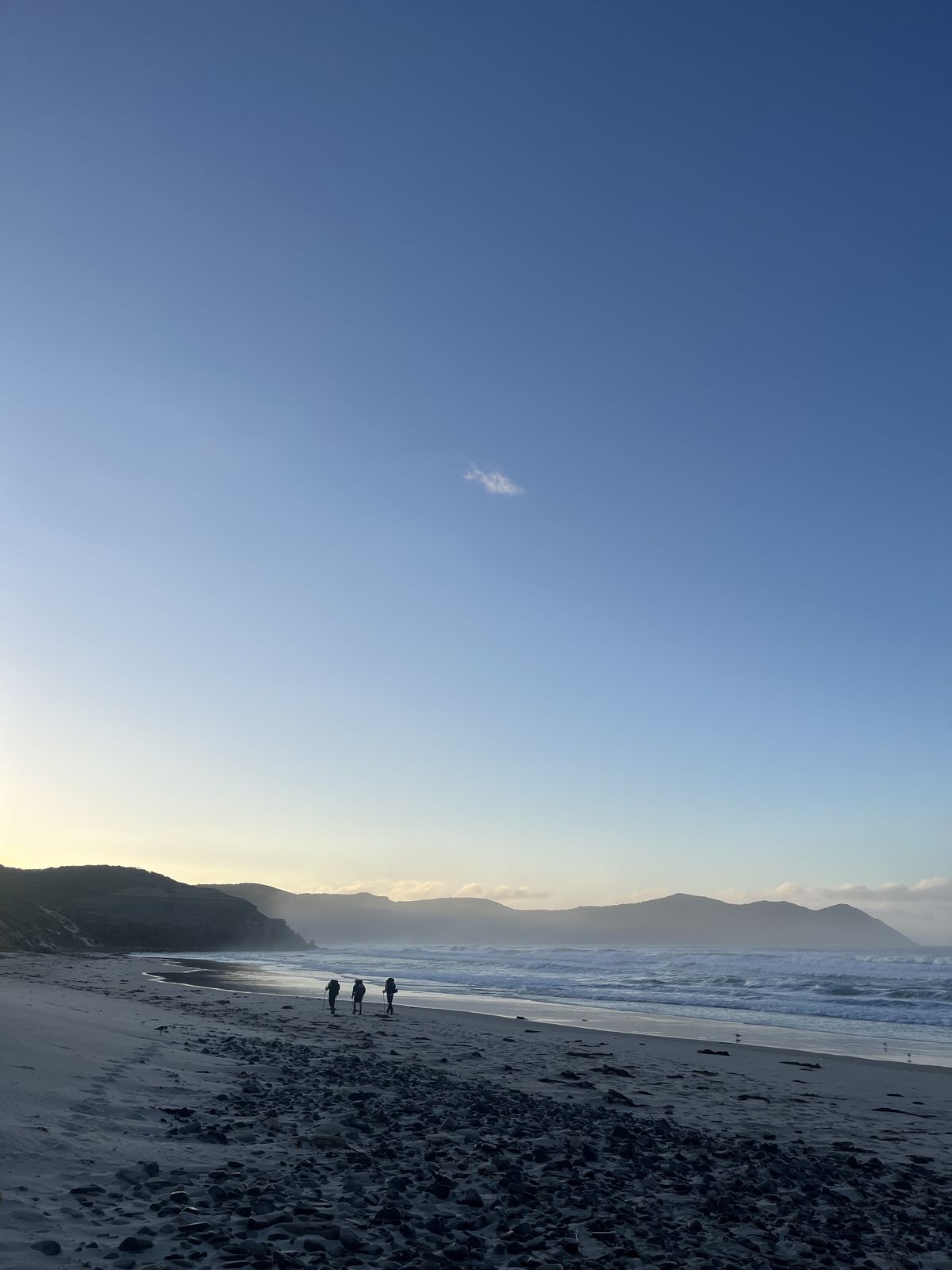
Prion Beach is one of the longest sections, a long straight beach that stretches for kilometres. On my second hike, I saw another person in the distance. Just a dot. It took 15 to 30 minutes of walking for that dot to become recognisably human. The beach is so straight and empty that scale becomes confusing.
Walking along Prion Beach after 10 days of wilderness feels like you're on the edge of the world. The beach is pristine. The only footprints are yours and the person you're with. The emptiness is complete.
This is where I proposed the second time. Not because of any romantic moment, but because standing on an empty beach 5 days from civilisation, having survived 10 days of discomfort together, I realised that if she could choose to do this again, and we could laugh about it, then she was the person I wanted to be with forever.
The proposal wasn't dramatic. It was quiet, on a beach, surrounded by emptiness, and perfectly right. She said yes. We kept walking. There wasn't champagne or a photographer hidden behind a rock. Just two people who'd been cold and wet and tired together for 10 days, standing on a beach at the bottom of the world, deciding to keep doing life together. That felt more real than any planned proposal could have been.
New dispatches from the field
Real stories. No spam. Unsubscribe anytime.